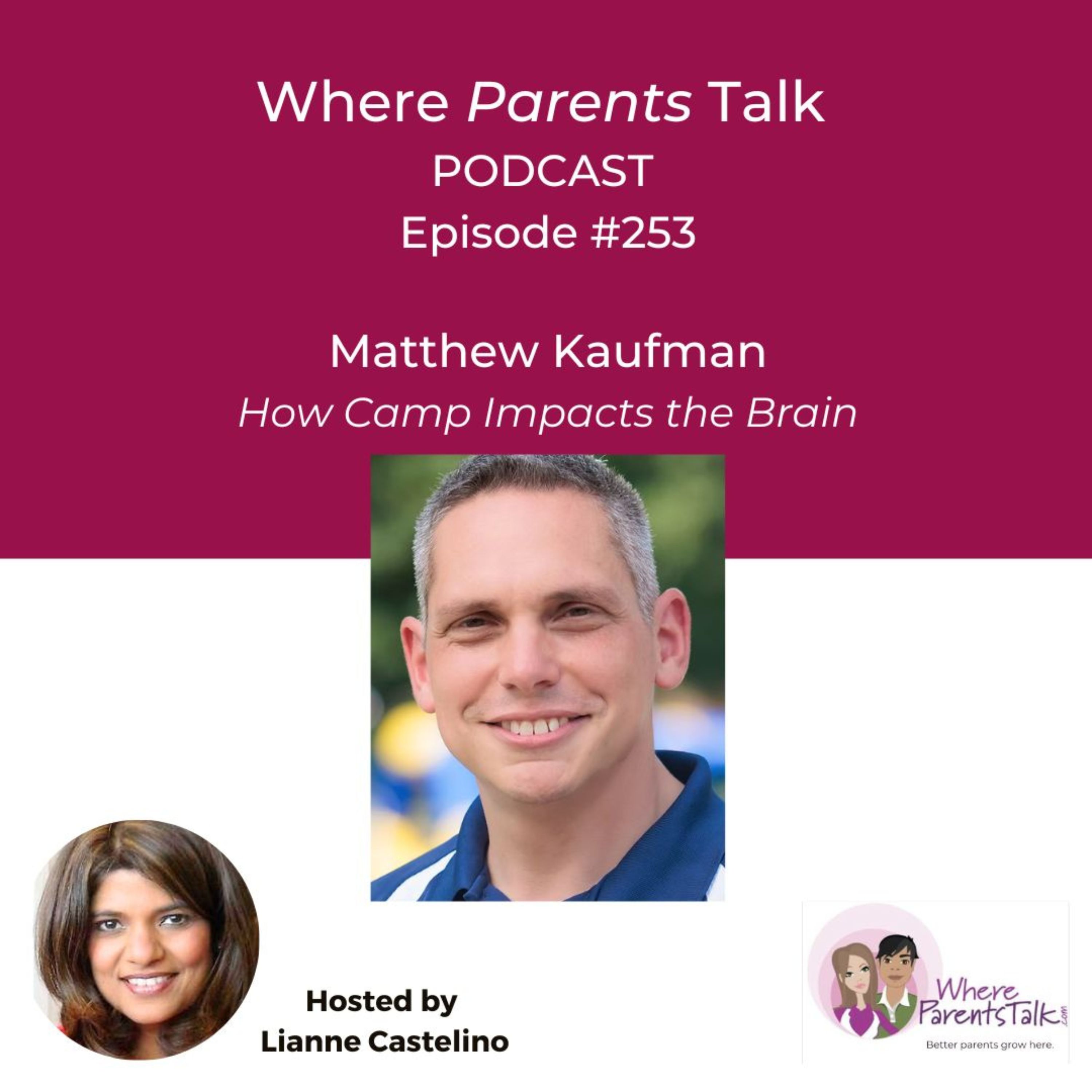
In this episode of the Where Parents Talk podcast, host Lianne Castelino speaks with Matthew Kaufman, camp director, author, lifelong camp professional and father, about the powerful science behind camp and what parents can learn from it.
Drawing from his book The Campfire Effect: How to Engineer Belonging in a Disconnected World, Kaufman explains how camp environments intentionally create safety, belonging, and healthy challenge—and why those elements are essential for learning and emotional growth.
Parents will learn:
- Why children can’t learn or grow unless they feel emotionally safe
- How positive stress (not zero stress) builds confidence and resilience
- The role of brain chemicals like cortisol, oxytocin, and endorphins in child development
- The difference between supporting a child and rescuing them
- Simple, practical ways parents can recreate “camp-like” belonging at home through rituals and connection
This conversation supports parents navigating anxiety, screen overload, and the pressure-filled school year.
This podcast is for parents, guardians, teachers and caregivers to learn proven strategies and trusted tips on raising kids, teens and young adults based on science, evidenced and lived experience.
You’ll learn the latest on topics like managing bullying, consent, fostering healthy relationships, and the interconnectedness of mental, emotional and physical health.
Links referenced in this episode:
Transcript
Speaker B:
Welcome to the Where Parents Talk podcast. We help grow better parents through science, evidence and the lived experience of other parents.
Learn how to better navigate the mental and physical health of your tween teen or young adult through proven expert advice. Here's your host, Lianne Castelino.
Speaker A:Welcome to Where Parents Talk. My name is Lianne Castelino. Our guest today has spent the majority of his life involved in summer camp, first as a participant and administrator.
Matthew Kaufman is a camp director and an author. He is the author of The Summer Camp MBA 50 Leadership Lessons from Camp to Career.
And his latest book is called the Campfire how to Engineer Belonging in a Disconnected World, which delves into the neuroscience of of what makes camp impactful. Matthew's also a father of one, and he joins us today from Pomona, New York. Thank you so much for making the time.
Speaker C:Sure. I'm glad to be here.
Speaker A:How would you go about, Matthew, trying to characterize what summer camp and the impact that it has had on your life, both personally and professionally?
Speaker C:So I started at the camp that I work at when I was four years old. I was a camper and I basically never left. So I've been here for over 40 years.
I spent 11 years as a camper and then became a counselor and went on to be a division leader. And I'm currently one of the directors here. And it's been the backdrop to my entire life.
So it's difficult to explain the impact it's had on my life because it's really been the one constant that I've had basically for as long as I can remember.
And when I walk through my camp, I like to say that I have to sort of push the memories away because it just feels like I'm walking through a sea of all these memories of my entire life, my childhood, my young adulthood, and now my adulthood. So it's really been just everything, the backdrop to everything that I've done in my life.
Speaker A:What is it about this experience that has so sort of enamored and taken over so much of your life in different ways?
Speaker C:What is it about this experience is actually a question that I've been asked so many times in my life.
Speaker A:He is the author of The Summer Camp MBA 50 Leadership Lessons from Camp to Career, and his latest book is called the Campfire how to Engineer Belonging in a Disconnected World, which delves into the neuroscience of what makes camp impactful. Matthew is also a father of one, and he joins us today from Pomona, New York. Thank you so much for making the time.
Speaker C:Sure. I'M glad to be here.
Speaker A:How would you go about, Matthew, trying to characterize what summer camp and the impact that it has had on your life, both personally and professionally?
Speaker C:So I started at the camp that I work at when I was four years old. I was a camper, and I basically never left. So I've been here for over 40 years.
I spent 11 years as a camper and then became a counselor and went on to be a division leader. And I'm currently one of the directors here. And it's been the backdrop to my entire life.
So it's difficult to explain the impact it's had on my life because it's really been the one constant that I've had basically for as long as I can remember.
And when I walk through my camp, I like to say that I have to sort of push the memories away because it just feels like I'm walking through a sea of all these memories of my entire life. My. My childhood, my young adulthood, and now, now. Now my adulthood. So it's really been just everything.
The backdrop to everything that I've done in my life.
Speaker A:So interesting that you started at 4, which seems incredibly young for people who maybe don't have kids that go to camp or maybe who do send their kids to camp. Four seems a bit young.
How would you sort of try to articulate, like, what is it about this experience that has so sort of enamored and taken over so much of your life in different ways?
Speaker C:So let me just clarify that. This is a day camp, so my parents weren't sending me off to a sleepaway camp at 4 years old. That is certainly a little bit extreme.
But what is it about? This experience is actually a question that I've been asked so many times in my life because it is a bit unusual.
And my background is an engineering background, so I have more of that analytical type of background. And people would think that I would do something different with my life. So I've been asked that question a lot.
And in my head, the answer to that question takes hours to answer. And.
And that's one of the reasons why I wrote the Campfire Effect was because people kept asking me that question, and I decided, hey, let me just write a book to explain it. So that's what I did. But very, very long story short, I find camp to be the most challenging environment for me.
And I like to be challenged and I like to learn.
And it's very interesting because the academic part of my childhood, going to school, taking tests, all that kind of stuff that came Very easy for me. And camp was actually the hard part.
Going to camp, having to be social, not having the same kind of structure that there is at school, was really challenging for me. And I think ultimately that's what drove me to appreciate the experience so much.
So that's a little bit about why I do what I do, because I think the experience was so valuable for me that I. I'm really, you know, I'm so excited and enthusiastic about having younger people get the same kind of experience that I had, especially these days, when I think people need that kind of experience so much, with everything going on, with technology and screens and phones and all those challenges that I never had to deal with as a child, but now these. These young people have to deal with all these extra challenges that are relatively new in our world.
Speaker A:Paint a picture for us, if you could, Matt, about when you were that young boy going to camp at the age that you did. What were you like when you first entered camp, and how did it shape you in what ways?
Speaker C:I will paint a picture of my first day at camp, which probably was the same thing for the first several weeks of my camp experience. And I actually do remember my first day at camp. I got on the bus with my sister, and my sister's a little bit older than me.
She's three and a half years older. And we sat next to each other on the bus. And my sister's a great person.
And the story that I'm going to tell makes her sound like not a great person, but she totally is a wonderful person. I want to get that out of the way. So the bus ride was wonderful because we were talking, and I felt really safe with my sister.
And as the bus pulled into camp and we started to get off the bus, I asked her, where do I go now? And I distinctly remember her saying, I don't know where you go. I know where I go. And I was so nervous.
And I got off the bus, and of course, there were staff members there and adults there to guide me exactly where to go. But that moment of panic, that moment of fear, I distinctly remember that to this day. And I was extremely shy. I was a very, very shy child.
I'm naturally introverted, and as a younger person, that. That became a fear of shyness. And I struggled. I definitely struggled. I cried a lot of the time my first few weeks at camp, and I was homesick.
I missed my mom. I missed being in my room and my house. And people asked me, when did it change? And it didn't change. There's no moment that you can look back at.
A lot of people in the movies, they would have this magical moment where something happened. But it doesn't happen like that camp. It happens with small moments.
The time when you sit and you're doing an art project and your friend next to you says, hey, I really like your picture. Or when you're struggling and you don't want to play in the game and your counselor comes over and puts their arm around you and says, that's okay.
You can hang out with me until you're ready. And it's an accumulation of moments like that that build safety. And you can't do anything. You can't grow, you can't learn.
You can't do anything unless you feel safe. So just over time, a collection of those moments at camp made me feel safe and made me really appreciate the experience that I was going through.
Speaker A:You talk about being a shy child. At the same time, I understand school came very easily to you. So then what was camp giving to your brain? Do you think that school wasn't?
Speaker C:I think that camp was giving me challenge. It was challenging me in very, very different ways from school. And the wonderful thing about camp is that it doesn't just challenge you.
It gives you support. It gives you people that care and the time and the space to grow. So at school, you're expected to learn something.
You take a test, and then you get a grade, and it's pretty much binary. You either did well or you did poorly at camp. It's not like that. There's a spectrum.
And just because you didn't do something very well this moment doesn't mean that you won't do it well in an hour or the next day or the next week. And I often share a story about a child that is climbing a ropes course. And this is difficult for a lot of children.
A lot of people, including me, have a fear of heights and climbing a ropes course. Climbing a climbing tower can be difficult.
And imagine, if you can, a child who's at the base of the tower and getting ready to climb, and they just can't do it. They're just too scared. They're jittery, they're nervous, and they say, I can't do it. In school, that's an F on a test.
But in camp, what happens is that there's a counselor or a staff member at the bottom of that climbing tower encouraging that child and saying something like, that's okay. You don't have to climb to the top, but let me see you try. Let me see you take two holes or go 10ft up. And I understand how you're feeling.
I was nervous the first time I did this too. And you start to see that child climb.
And even if they only made it up 5ft or 10ft, they learn more in that moment than the child who climbs to the top, having no fear of heights. And that's what I think is a little bit different between school and camp. It's that school, it's sort of this. You get a grade, and that's.
That's the answer. At camp, it's much more fluid, and you're given your. Your own.
Your own time and your own space, but you're given the support of people that truly care about you to learn.
Speaker A:So are you saying that school and the education system could take a lesson or two from the way camps are structured?
Speaker C:Absolutely. Absolutely. I think that we're starting to see more schools take some lessons from camps. Very fortunate.
As a camp director, I get to work with a lot of teachers, and the teachers that I work with, they all take the lessons they learn at camp and they bring it into their classrooms. And one thing that I mentioned in the book is that children cannot learn if they don't feel safe.
And I can even remember this as a teenager in a high school where I switched to a different school when I was 14 years old, and I didn't know anybody. And it was just uncomfortable for me, as you can imagine, a 14 year old in a new environment.
And my grades suffered for a semester or two until I found my footing. So the best teachers know that they can't teach kids unless they feel safe.
And they take a few minutes in their lesson or in their day and they create some kind of ritual or some kind of experience for kids to make them feel like they belong in that classroom. And it's not a waste of five minutes. It buys them the other 40 minutes of the class time to actually get some learning done.
So I see teachers taking these concepts and using them in the classroom.
And I would love to see just a larger scale of maybe on a government level or a citywide level where some of these concepts were instituted in schools. And I think kids would really, truly benefit from it.
Speaker A:When you talk about safety, it's obviously a large word. It means different things to different people. And many parents might not think of safety exclusively in the ways that I think you're describing it.
So how do you define safety for a child in a camp or in a school environment?
Speaker C:Right. So. So when I talk about Safety. I'm including everything Physical safety, emotional safety. And it's difficult to define, but.
But there's something you can see when you look at children that don't feel safe, and they're. They're kind of always on high alert. And if you're really attuned to body language of children, you can.
You can sense when they're not feeling like they're safe. And one of the key things is, can a child feel like they can make a mistake without being ridiculed or judged or some other negative repercussion?
Because you don't learn anything unless you make mistakes. And that's what I look for when kids are. When I'm judging whether kids are feeling safe or not safe is. Can they do. Can they fail and laugh about it?
You know, can. Can. Can they try something new without. Without the fear of. Of being judged or. Or being made fun of?
Speaker A:You talked about your book the Campfire Effect. Take us through what your approach to writing this book was.
You talked earlier about, you know, people asking you questions that you tried to answer in this book, but what was your mindset in terms of what you wanted to achieve with the Campfire Effect?
Speaker C:So I started writing this book in my head probably five years ago, because people kept asking me, what is the magic of camp? What is the magic of camp? Why?
The parents were saying, why do my kids come home and they can't stop talking about camp, and they can't stop counting down the days for school to end so that they can go to camp? And why are they the best versions of themselves during the summer?
During the winter, they're stressed, they're anxious, and during the summer, they just feel like that kid that they should be. And, you know, I had answers and. And I would.
I would take guesses, but with my engineering background, I really started to think about it and say, hey, there's something going on here that's not magic. This isn't magic. Magic doesn't exist in the real world. And I started doing some research, and it's actually neuroscience. It's brain chemicals.
And it's these brain chemicals that are activated at camp in a certain order and a certain way that create a sense of belonging that allow children to thrive and grow and learn. Because, like I said, you can't do anything until you feel safe.
So the first thing that camps do, and they do it really well, most of them, is they create a sense of safety. And we talk about the chemical of oxytocin, which is often called the bonding chemical. It Makes people feel safe.
And the oxytocin is released through things like rituals and continuity activities. So camps, I truly believe that camps have sort of stumbled upon this magic recipe through 100 plus years of trial and error. But it's not magic.
It's science.
So basically, as I was doing my research, I started to realize that I'm not just answering this question about camps, but it can also be applied to schools and workplaces and families. And these five chemicals exist in all human beings, not just children. It actually applies to adults as well.
It applies to parents as well as children. So that was kind of the impetus for the book, is to explain what camps do and that it's not magic, it's science.
And the best camps are intentional, and the best camps build intentional communities. And this pulls back the curtain on how that happens and why that happens.
Speaker A:So about that neuroscience, what, at a basic level, do you think parents really need to understand about the science behind the impact of camp?
Speaker C:I think the one thing that sticks out to me as being the most important for parents is the role that cortisol plays. And cortisol is often called the stress, the stress chemical. And people will complain. I'm feeling so stressed, I have so much cortisol.
How do I get rid of this cortisol? And I think there's a little bit of a lack of understanding about the role that cortisol plays. Cortisol's not an evil chemical.
Cortisol is only bad for you when it's not moderated.
So when you're trying something new or you're learning something, or you're in a position that you've never been before, your cortisol will naturally spike. What camp does is it creates a situation where you're supported by other people.
You're supported by counselors or staff members or your friends, and that gives you other chemicals, such as oxytocin and serotonin, that allow cortisol to drop, to be moderated. So the fact that you're stressed and you have a cortisol spike is not bad in and of itself.
It actually gives you the energy and the drive that you need to accomplish the thing you want to accomplish.
It's just that when that cortisol is unmoderated and there's never a reset and there's never any support, which happens to a lot of people in schools and in workplaces, that's when cortisol almost becomes like a toxin in your body. So I think that's the one thing that I would share, is There's a difference between a child in distress and a child in eustress.
So eustress is this positive stress where you. You're learning, you're growing. It's hard. You're feeling this, you know, surge of, of adrenaline and all that stuff.
But it's in a supported and safe environment.
Speaker A:You've been in this industry in some capacity for the better part of 40 years.
And I'm curious, as you were looking at the research, the neuroscience, et cetera, in the course of putting together this book, what surprised you most? Perhaps something you did not know about the impact of camp.
Speaker C:I think what surprised me was the sort of. Overall, what surprised me was that there is legitimate science to back up everything that camps do.
I wasn't necessarily expecting to get such data, such hard science data to back up the role that these chemicals play in a day at camp. And I think the other thing that, that surprised me was the role that endorphins play.
And people think of endorphins, the classic term is the runner's high. It's that when you move, when you exercise, endorphins actually release something that masks the pain.
And evolutionarily speaking, this came from when, when, you know, tens of thousands of years ago, when we were. When we were chasing animals to try to find our dinner. Endorphins would help us do that by masking the pain in our muscles.
But nowadays we obviously don't do that. And the role that endorphins play are essentially a reset.
And they help just get all that cortisol out of our body and just give us the energy to actually do these hard things and learn new things and grow. So I wasn't really expecting to find there how endorphins impact our. Our bodies in that way. And that was.
That was kind of cool because people don't realize this, but endorphins are also released when you. When you laugh. And at camp, we do a lot of laughing. We do a lot of laughing and singing and dancing. And that releases a ton of endorphins.
So there's really science behind it. We're not just having fun. We're actually. We're actually doing important work.
Speaker A:It begs the question. When a child goes to camp, parents will often say, well, they come home changed. The camp has changed them in some way.
Why do those experiences not stick beyond a few weeks of camp? What's happening that it's not sustained?
Speaker C:We hear that too, and we love half of that. We love that camp is changing kids for the better. And it saddens us that it doesn't always stick. Sometimes it does.
Sometimes we hear that the confidence that they get at camp stays with them the rest of the year. And I think that's important to recognize.
But I think that a lot of what happens in schools and the rest of the year is just so different from what we do at camp. And I have the utmost respect for the school system and for teachers and for parents and for everybody.
But when you leave the bubble of camp, it is so much more challenging to recreate the environment where there is an intentional sense of belonging.
And as I mentioned a little bit earlier, I think it's gotten so much more difficult with screens and with social media and all the technology that's happening, because those, those things build walls between people. We think that they connect people, and in some sense they certainly do.
But for children, especially teenagers, that is putting up a wall between them and other people for real world connections. They have all of these screen connections, but none of the real world connections.
And in order for real growth to happen, you need the support of other people. And when you spend your life on a screen, you don't to want truly have that support as much.
So what we do at camp, it can fade over the winter because they don't feel the same, the same safety bubble and the same support from people, and they wind up just sort of living in that cortisol, living in that stress hormone instead of the positive hormones of oxytocin, serotonin and dopamine and endorphins.
So I think it's sad, and I think that it takes a lot of effort for the rest of us, the other 10 months of the year, to create this environment for children.
Speaker A:So about that, about the 10 months of the year where they're in school and not in camp, what would you suggest that parents could do to continue to support maybe some of the positive changes that their child, if they go to camp, learned and continue to maintain that?
Speaker C:Yeah. So I give a few examples in the book. At the end of every chapter, there's a few examples of small things that you can do.
And I think it's important for parents to realize that you can't go and try every trick in your bag of tricks all at once. It's a slow buildup and you have to be committed to it. And there's no magic tricks here.
One thing that I love, just in my career and in my life, something I truly love are rituals and the concept of rituals. And I would say if you want to start with something today. Start with adding some kind of ritual for your child.
And it's especially beneficial if it's a moment where they're extremely stressed. So if a child gets very nervous before they have to get on the bus, you can create a ritual for that. And it can be something very simple.
Like it could just be, before you get on the bus, I'm going to squeeze your hand three times, three times for I love you. Right. It takes three seconds. And it grounds the child in just in a sense of safety.
And build upon that the more rituals you have, it's not just about the routine, but when you create a ritual, I always use the acronym of make your rituals messy. M E S S. So a ritual should meaningful, emotional, sacred, and scripted. So if you create a ritual, it needs to have a meaning.
It needs to mean something like the three. The three squeezes means I love you. Emotional. It should evoke an emotion. It doesn't have to be sadness or feeling somber.
It could be joy or happiness. Sacred simply means that the ritual is different from anything else. Right. So this is a time set aside for that ritual.
And scripted just means it needs to be pretty much the same every time. That's what makes a ritual a ritual. So I would say you want something pretty quick and easy to add to your life with your children. Create a ritual.
And create two is better than one and three is better than two.
Speaker A:You've talked about camp as it relates to creating an environment of safety, of belonging for kids, of them feeling safe enough to try to take risks. What's the difference? Especially in the world we live in where, you know, there's a lot of helicopter parenting that still goes on.
What's the difference between supporting a child and rescuing them? And why does that matter? What do parents need to know about why there's a difference and why it matters?
Speaker C:It's not always easy to know when you're rescuing and when you're supporting. I try to keep an analogy in my head, and I think it's helpful for parents.
So when a child is climbing a climbing wall, they're harnessed in and they're attached to a rope, and someone's holding that rope so that they can't fall. And the person holding that rope is called a belayer.
They're belaying the child, and they're the person on the other end of the rope keeping them safe. The belayer is not climbing the climbing wall for the child. They're supporting the child.
So I think that in any situation, ask yourself, are you climbing for the child or are you belaying the child? And that's a. That's a good way of thinking about it. In.
In my head, you don't want to be the parent that takes away the thrill and the joy and the learning that comes from climbing a climbing wall. You also don't want to be the parent that sends the child up the climbing wall with no harness whatsoever. Right. There's a happy medium.
So always try to be the belayer. Don't climb for the child, and don't tell the child they can't climb at all.
Speaker A:It's a wonderful image. It's an excellent example. I think we can all picture that as you describe it.
It's one of many challenges that are offered at camps, activities that are designed to have kids be challenged. Why is that kind of stress actually healthy for a child?
Speaker C:So when a child does something that they never thought they could do before, they wind up telling themselves a story, right? Everyone tells themselves a story.
And when children do these activities, whether it's a climbing wall, a zip line, or passing a swim test, or scoring a goal in soccer, or doing something they never did before, they start to tell themselves a positive story about themselves. I'm the kind of person that can do hard things. I'm the kind of person that can try something new.
I'm the kind of person that can go out of comfort zone.
And when you build up enough of these stories over time, it changes who you are for the better, and you become the kind of person that has confidence and does incredible things in the world. So that's why I think it's such a disservice when we don't allow children to challenge themselves in the name of safety.
Of course you have to be safe, but you also have to challenge kids.
So you have to find that balance of how do you challenge kids safely so that they can wind up telling themselves these stories about how they have confidence and how they feel safe trying new things.
Speaker A:What would you say, Matthew, to a family or parents who have not considered sending their child to camp as to why this is something that they may want to consider based on the neuroscience, certainly your lived experience and other things that you've incorporated in both of your books.
Speaker C:So I think that sending a child to camp is one of the great gifts you can give them. And I was fortunate enough to receive that gift from my parents. And it can be a struggle. Right.
There are camps at all different price points, but it's not considered basic childcare necessarily. So I understand that it could be a struggle. And I think that the idea behind camp is that it's an investment.
It's an investment in building skills that the kids simply don't get in schools.
And there's this concept nowadays of Moravec's principle, which basically looks at artificial intelligence and says that artificial intelligence is able to do all the difficult things that humans can do, but it can't do some of the easier things that humans can do. So it kind of flips the pyramid upside down. So to get a little bit more detailed about this, artificial intelligence can code.
It can code really well. So we used to tell kids, go to college, learn how to code, you'll have a job forever. That's not the case anymore.
AI can code, but what AI can't do are some of the soft skills. AI can't put their arm around another person and say, hey, I know how you're feeling and we're going to get through this together. AI can't do that.
Those are the kinds of skills that camp teaches. Camp teaches the social skills. Camp teaches us how to be good people, how to be good teammates, and how to be good leaders.
So when you think about camp and finding the right camp is so important, you don't just. Not all camps are created equally. So you want to find a camp that understands that those skills are incredibly important for children.
So you need to think of it as an investment. It's not just a place for kids to go and play kickball all day.
Speaker A:Speaking of kids, you have a 10 year old daughter. Curious as to how your experience with camp through all these years has impacted your parenting approach with your own daughter.
Speaker C:Well, my daughter's two. Oh, two. Sorry.
Speaker A:Yes, two.
Speaker C:So she's not at camp yet. But what I've seen with children, it impacts everything that I do with my daughter.
And even at this age, I'm very cognizant of trying to let her figure things out on her own and not always be the answer. And that's again, trying to challenge children in a very safe way. So it's all age appropriate.
However, even at this age, she wants me to do things for her that she can do herself. And I think something I learned from just working at camp all these years is that I need to resist that urge.
As much as I want to do it for her, I need to have her struggle a little bit because that's going to make her a better person.
Speaker A:How do you resist that urgent.
Speaker C:I don't always do it well, if.
Speaker A:I'm being honest, that's a Challenge in itself, definitely.
Speaker C:Exactly. But there's a little voice in the back of my head saying, hey, just count to three before you go in and help her, see if she can figure it out.
And I'm getting better at it, but believe me, I understand how difficult it can be.
Speaker A:If there's one thing, Matthew, that you'd want parents to remember about the impact of camp in terms of a child's development, what would that be?
Speaker C:I think the one thing that's really important for parents to know about camp is that camp is not always perfect for children. And it's not supposed to be. That's the point.
Kids are going to learn that they can overcome struggles, they can do hard things, and they do that with the help of their peers and with supportive staff members. So don't expect camp to be perfect, because if it's perfect, children are not learning anything.
Speaker A:Now, you also talked about earlier how camp can be used in terms of the things you learn in camp in different aspects, in different parts of life, whether in the business world, etc. Etc. Can you leave us with some examples of what that looks like and why that's important to keep in mind?
Speaker C:Sure. And because we didn't touch upon it too much, I'll relate it to working at camp.
So I often say working at camp is the best first job a person can have. And our staff at camp learn incredible skills. Leadership, time management, overcoming obstacles, working within a team.
And they learn these things as teenagers and they have no choice but to get really good at it. So when they go out in the business world and they're looking to be hired by all these corporations, they have such incredible stories.
They can tell of real world examples of how they exhibited grace under pressure. They had these time management skills and they diffused conflict. And they worked in a group where maybe they didn't get along with everybody.
So I just, I think that really savvy business leaders are hiring people that have the kinds of skills that our staff develop at camp.
Speaker A:Lots of wonderful food for thought things to keep in mind. Definitely. Matthew Kaufman, camp director and author of the Campfire Effect. Thank you so much for your time and your perspective today.
Speaker C:Thank you. Great to be here.
Speaker B:Thank you. To learn more about today's podcast guest and topic, as well as other parenting themes, visit whereparentstalk.com.