
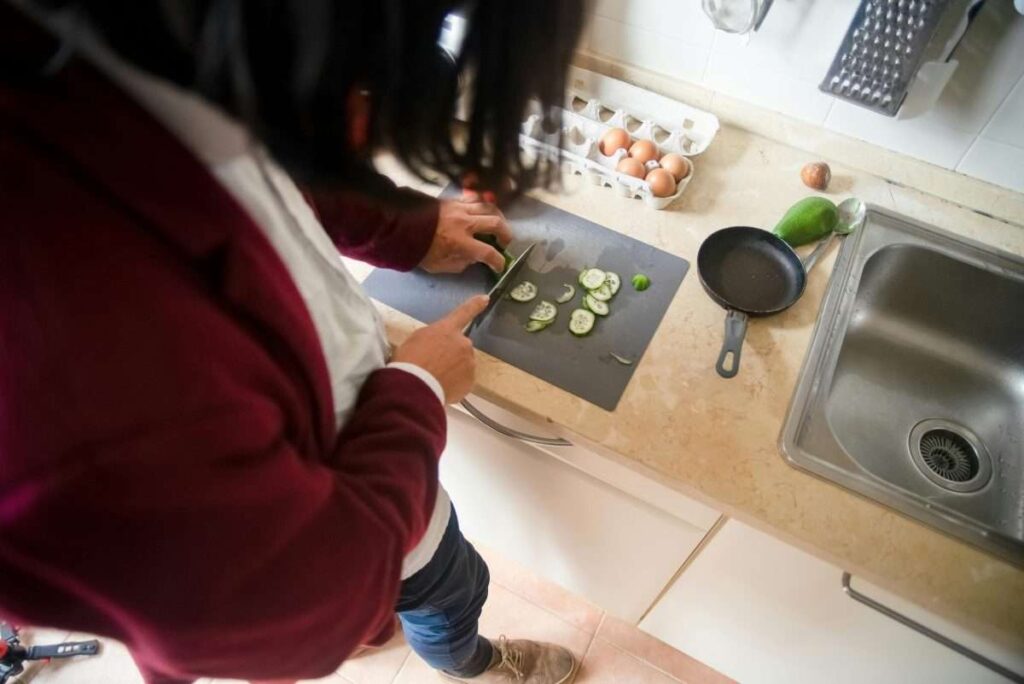
Feeling mentally cluttered or emotionally drained? Don’t worry, we all have our days. However, lately, more than ever, everything feels cluttered, both our minds and our environments. And among all the places in the world, it is that everything finds its way back to our beloved kitchen. All the crisis, the trauma, the melodrama are just rising to the surface of our kitchens. Good thing we do not suppress them any longer, but still, in the kitchen? What a mess. It would be infinitely more polite if we’d chosen to let’ say, scream, instead of gradually transforming our cooking space into a living nightmare. Yes, you’ve heard us. If you feel like screaming, who’s stopping you, honestly? There is no such thing as right and wrong when it comes to the way one decides to temper the agony. Of course, as long as drugs and black alley hookers are on your list. Besides that, you are damn free. You can scream, loud, ugly, primal. You can draw your ex’s face on a dartboard. You can curse in your journal. Cry in supermarkets. You name it.
But don’t, under no circumstances, clutter your kitchen. It will eat you alive. Cluttered kitchens are the new energy vampires, period, exclamation mark, blood oath. Psychologists may call it “visual noise”; interior theorists call it “domestic therapy”. Either way, it’s real, and it’s ruthless. And we are not saying that because social media devotedly portrays the empty sink as the new status symbol. Actually, we are saying it because….
Keep reading if you’re interested in finding out more.

Image source: freepik.com
Kitchen Clutter And Mental Health
If you’ve ever felt like smashing a glass against the wall when confronted with the reality of what a mess your house has become, then you should not have problems recognizing that cleanliness and mental health share an intrinsic connection. Research suggests that living in a cluttered kitchen can significantly affect stress levels, particularly for young women caring for an infant. Moreover, researchers have found that clutter bombards the brain with stimuli, making it harder to concentrate on a single task and leading to feelings of anxiety, overwhelm, and decreased productivity. More specifically, they have discovered that our virtual cortex may be easily overwhelmed by objects not necessarily related to a particular task. Moreover, as clutter represents a lack of completeness, it is only natural that our brains interpret it as highly stressful. Just imagine, you save for years to build the kitchen of your dreams, such as the popular handless matt replacement kitchen doors purchasing only the crème de la crème in terms of items , only to let it descend into chaos. And, of course, the result is predictably catastrophic.
Funny how over time, maybe we all have so assuredly mocked people who clean to quiet their minds. However, evidence suggests that the actual act of cleaning/decluttering can significantly boost the mood, as it challenges both our bodies and minds. We move, focus (or at least try to), and overall feel more in control of our surroundings.
But Letting Go Feels So Hard…
No, for there is an actual reason as to why decluttering feels so hard, and science backs it up:
- Memory attachment: As twisted as it may sound, grief and guilt can truly tangle themselves into objects. Neuroscience shows that a pan, for example, isn’t just a pan anymore. It’s the very person who gave it to you last Christmas, the smell of pancakes that morning, the soft Grinch pajamas they wore, and everything that quietly stitched the moment together. Here, the pan becomes a trigger, and that is why parting with such an ordinary object can sometimes feel like erasing a piece of your life.
- The Endowment effect: Psychology research shows that our brains perceive value differently, particularly when the context suggests we owe something. In this scenario, the brain will assign that specific object significantly more value than it actually has, and suddenly, a $1 mug can feel priceless, just because it belongs to YOU. That may be the case with ex-boyfriends as well. He might’ve been Mr. Bean, but he was yours, so your brain mistakenly thought he was Brad Pitt.
- The power of touch: Here, the logic is simple. Just because we have touched something, felt its weight, the brain automatically understands “This is mine.” The longer we touch it, the stronger the sense of ownership becomes. Tricky, right? Particularly as we consider that, after all, physical affection is poised to nurture emotional attachment. No longer stranger-kissing in the club? No, not really, but still, you’ve got the idea.
- Fear of regret: Who would’ve thought loss aversion extends beyond trading? All of us, probably. The nagging thought in our heads, “What if I need it someday?”, yes, it is completely loss aversion. Largely, this is who we are. We’d rather avoid loss than seek gain.
Things To Throw Out From Your Kitchen ASAP
The “Why do I still have this?” kitchen hall of fame:
- Old cookware: If it hasn’t seen action in years, it’s probably just collecting dust and taking up prime cabinet real estate.
- Warped cookware: Cooking on this is like playing Tetris with your food.
- The old bottle of olive oil: That bottle went rancid three years ago, but somehow, you’ve convinced yourself it’s “aged gracefully.”
- Leftover rice: Unless you want a science experiment growing in your fridge, it’s time to say goodbye.
- Warped plastic storage containers: They don’t close, they don’t stack, and yet you keep believing they will magically fit.
- Sponges: You’re basically inviting bacteria to live rent-free; replace them before they unionize.
- Chipped cups and bowls: Every sip or bite comes with a side of danger; beauty isn’t worth a trip to the ER.
- Ceramic items that may contain lead: That decorative plate isn’t worth poisoning your dinner; toss it before it tosses you.
- Expired pantry items: Expired doesn’t mean “extra flavor,” it means “a stomach rebellion waiting to happen.
- Unused appliances: They promise convenience, but if they’ve only seen the light of your counter once, they’re just dust magnets.