As artificial intelligence rapidly reshapes the world our children are growing up in, many parents are left wondering: What does this mean for my child’s identity, values, and future?
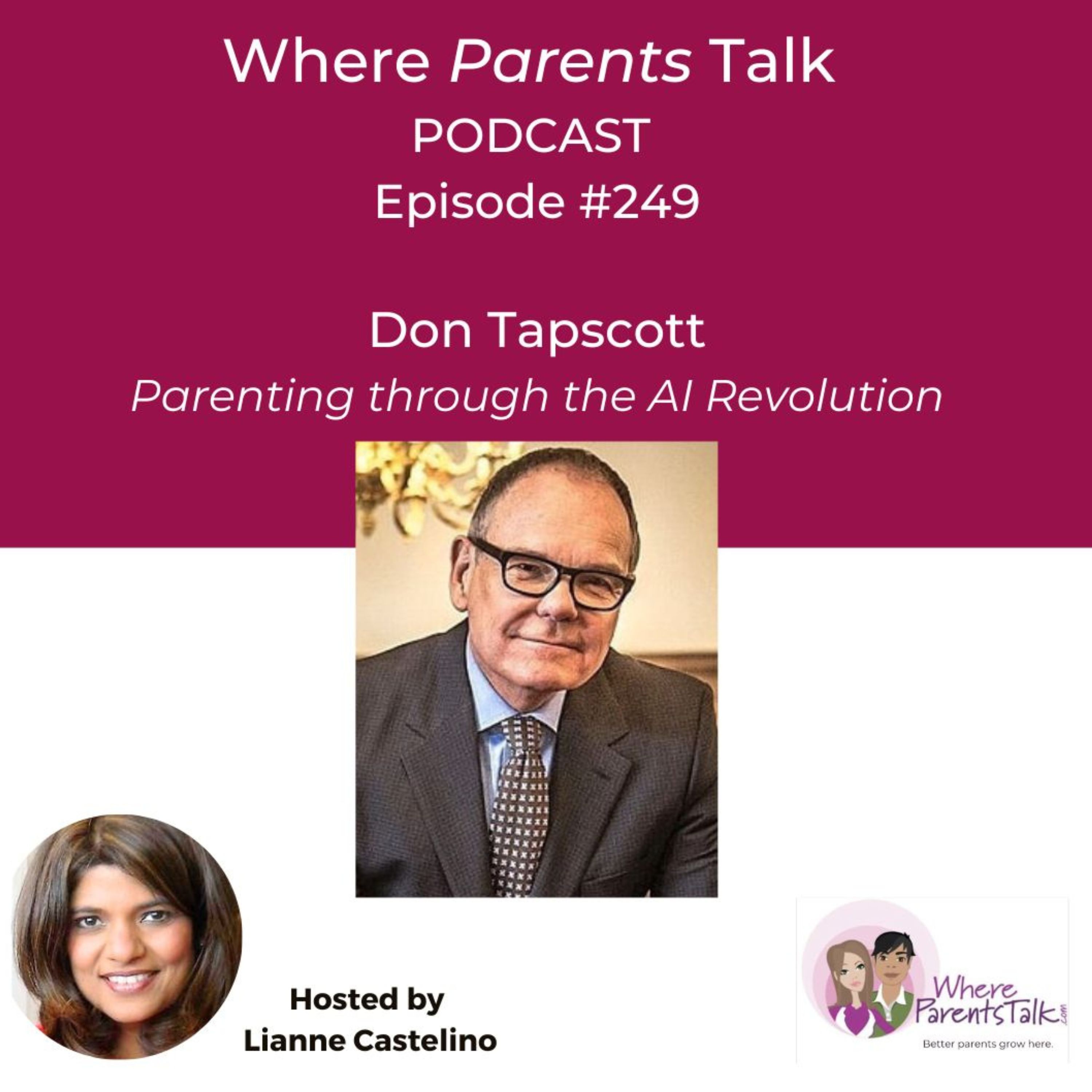
In this episode of the Where Parents Talk podcast, host Lianne Castelino speaks with global technology thought leader and author Don Tapscott to explore the rise of identic AI and why understanding it is no longer optional for parents.
Drawing from his latest book, You to the Power of Two: Redefining Human Potential in the Age of Identic AI, Tapscott explains how AI is evolving from a tool we use into an intelligent extension of who we are — and what that means for families.
Together, they unpack how technology can shape children’s judgment, emotional health, and sense of self, why parents must move beyond fear toward informed engagement, and how creating a family “social contract” around technology can strengthen trust and communication. From digital identity and values to screen boundaries and critical thinking, this conversation offers parents practical insight and reassurance as they raise children in a powerful new digital era.
Takeaways:
- The rise of identic AI brings significant implications for how children navigate their identities online, emphasizing the need for parental guidance.
- As technology advances, parents must prioritize open communication and establish social contracts to ensure responsible device usage among their children.
- Understanding hormonal changes and their effects on tweens and teens is crucial for maintaining their emotional and mental health amidst social media pressures.
- It’s essential for parents to teach their children about consent and healthy relationships, especially in the context of digital interactions and social media.
- Navigating the complexities of bullying in the digital age requires a proactive approach to emotional health and effective communication with kids.
- Fostering independence in children is vital, yet it must be balanced with discipline and guidance in their engagement with technology.
Links referenced in this episode:
Companies mentioned in this episode:
- Blockchain Research Institute
Transcript
Foreign.
Speaker B:Welcome to the Where Parents Talk podcast. We help grow better parents through science, evidence and the lived experience of other parents.
Learn how to better navigate the mental and physical health of your tween teen or young adult through proven expert advice. Here's your host, Lianne Castelino.
Speaker A:Welcome to Where Parents Talk. My name is Lianne Castelino.
Our guest today is one of the world's most influential voices on how technology shapes our lives, our work and our society.
Dawn Tapscott is the co founder and Executive Chairman of the Blockchain Research Institute, a member of the Order of Canada and Chancellor Emeritus of Trent University. He is also a researcher, educator, musician and global best selling author who has written 19 book.
His latest work is called you to the Power of Two Redefining Human Potential in the Age of Identic AI. It explores the emerging intersection of identity and artificial intelligence and what that means for all of us.
Don is also a father and he joins us today from Toronto. Thank you so much for taking the time.
Speaker C:It's my pleasure.
Speaker A:Your book, as we just noted, introduces the era of identic AI. Take us through if you could, what that means exactly and what does that mean for families specifically?
Speaker C:Well, let's just do a little scenario. So flash forward.
Well, for a lot of people watching or listening to this podcast, flash forward a few months or a year and with apologies to the Beatles, you wake up, you get out of bed, you drag a comb across your head and before you go downstairs and take a cup, your identic agent has already been monitoring your health overnight and is recommending a change to your workout.
And it's selected a couple of articles that you actually care about and it's organized your day and flagged a traffic problem and it's reminded you that tomorrow's your sister's birthday and have some suggestions for presents.
And you arrive at the office if, say if you're a working person or your home office or whatever and your agent has not only mapped out your schedule, it's already solved a whole bunch of problems, had some issues with customers, we solved those, had some production problems, we solved those. You're looking at some new employees. I've reviewed not just their resume, but their agents.
And these are the employees that have really well developed their agents and will be high performance. And I recommend this one. And you know your day continues. It's attending conferences on your behalf as you're heading off home.
It says, good news, that real estate offer that you made. I've been able to close the transaction within your framework.
And I've already got three designs for your new house and three suggestions as to potential contractors. On and on and on. So how do you react to that? Do you think, wow, that'd be pretty great to have a superpower.
Do you think this can't be possible, that this is happening? I'm skeptical. Maybe you think, well, just a second, I'm kind of uneasy. Isn't technology already messing up our kids lives?
Social media is hurting them.
We've all ended up in these little reinforcing chambers where the purpose of information is not to give us information, but it's really to give us comfort for our preconceived ideas. And some people listening might be thinking, this is horrifying.
I remembered of the movie:Well, that's why we wrote the book you to the power of you to really, to answer these questions and just. I know it's a long answer to a short question, but to make the point or to be more direct, AI is changing fundamentally.
We all know about generative AI where we use ChatGPT and these things to generate content. The next stage was called agentic AI, where agents could do things without being prompted, take action on their own.
And now we have agents in call centers, supply chains, financial systems and so on. But they're really important agents.
The agents that are going to have the biggest impact on us, us as, as employees, as workers, entrepreneurs, as parents are the personal agents. Digital Leanne.
And Digital Leanne is going to be your infinite number of editors and developers and vice presidents, your doctor who's literally been to every business school or, sorry, every medical school in the world.
News read every text and your consigliere and your personal counselor and your parent co advisor and your librarian and your memory and your literal know it all because it knows all recorded information. And this is the, the biggest change ever. And it's a weird thing that this is coming. It's coming so fast.
There are no books about it and people are just starting to talk about it now. So this is the timely podcast and let's get into it. That's what it is.
Speaker A:Well, and you talk about this is coming and for a lot of our audience of parents, they're still trying to wrap their heads and wade through the minefield that is social media and some of those other platforms that we're aware of that, have been around for a while, maybe not as nimble in their understanding of artificial intelligence. So what do then parents need to keep in mind in what you've written in your book about identic AI?
Speaker C:Well, how much time have you got?
Speaker A:Top line?
Speaker C:e the book growing up digital:It was the first book really to talk about big book bestseller, talk about kids and, and technology. And some the conclusions from that book are really relevant to today in your question.
Like one of them was that this is the first time in human when children are an authority about something really important.
You know what I said in the book was I was an authority on model trains when I was 11 and today the 11 year old at the breakfast table is an authority on the Internet, the digital age, this technology that's changing every institution in society.
And rather than a generation gap like I had when I was growing up, kids and parents had big differences over values, lifestyle, hair, length of hair, ideas, ideology. That doesn't exist so much. It didn't exist then and largely it doesn't exist today. The kids and parents get along pretty well.
You know, there's a much more open relationship. You look at your playlist and your kids playlist, there's overlap. I mean there was zero overlap for my parents.
My parents didn't even like the Beatles, let alone the Rolling Stones or the, or the Doors or something. What we have today is something very different. I called it a generation lap where kids are lapping their parents on the digital track.
And what I said back then is if you have a teenager in your house, who's the system administrator in your home, you know, so flash forward to today, the same thing is happening, only it's so profound. Like I've got grandchildren, you know, my, my eight year old granddaughter.
The other day I was driving her and I left my phone, she's in the back seat and I left my phone on the little thing in between it.
She grabs my phone and somehow she got into it and she's putting a playlist onto the, onto the, the, the stereo in the car and she's texting my wife from my phone with a whole bunch of stuff, you know, little emojis and you know I really love you and all this stuff and I got some good points for that when I got home.
But, and I'm sure everybody watching this has this feeling, you know, that these kids, they're just, they have no fear of technology because it isn't there. It's like the air. It's like I had no fear of a refrigerator, you know, when I was growing up because I grew up with that technology.
So, so today kids are already using chatty, you know, or, or they're already using these tools. And as parents, the very first thing we need to do, you said top line, we need to get informed.
You know, like watching your kids lap you on this stuff is not an option anymore because as powerful as the Internet was, it's nothing compared to identic AI and the impact that it's going to have on everybody, including kids.
Speaker A:It's interesting because I've done countless interviews for this podcast over a number of years with experts, you know, leading researchers, evidence based, that and the other, about technology and parents and that gap, the chasm in some cases existing between parents and their children's understanding of technology. But what, what you're saying sounds like they don't have, they being parents today, don't have an option in terms of learning about this stuff.
It is now seems to sound like it has to happen. It's mandatory. Is that a fair statement?
Speaker C:Well, yes, it is because for a number of reasons. First of all, it's happening to all of us and those who say, well, I'm just going to sit this one out.
Like you go to work and your colleague has a superpower and you don't. I don't think that's really a viable alternative for us. You know, you, you want to develop your capabilities in some area.
You, you can now have a tutor who knows everything. People who harness the power of identic AI are, are going to have better health. They, they've got a doctor watching them 24 hours a day.
You wake up and your I AI said, wow, that was a tough night. I'd recommend some changes to your, your workout plan for today. You might want to take a nap.
And furthermore, there was something that happened in your blood pressure that's a bit of concern. I think this requires further testing and exploration.
So, you know, it's not an option for each of us and kids are going to get all over this faster than we are. And so it's, it's really, really critical.
Now that's not to say that parents should be attempting to, you know, get screens in front of their kids all the time.
I know with, with my own grandchildren, I've got four of them now, both of their parents, both sets of parents are super tech savvy people who work in technology related industries and they have Very restricted acts give their kids very restricted access to this technology. But you know that, that you use it for certain things. You can't, you can't use it during the week. You know, just these kinds of rules.
And, and by screens, we're talking about all kinds of screens, talking about mobile devices, but also big screens and all the other ambient screens and stuff that's happening in the world. So you need to have a plan and you need to have a strategy.
And the fact that this technology is infinitely more powerful than the previous waves makes this all the more imperative.
Speaker A:When you talk about a plan and a strategy for parents, what ideally should that entail, in your view?
Speaker C:Well, you know what we did with the first round, the Internet, we built a social contract in the home, and I think every parent should do that today. And it's a deal.
Social contract's a deal where each of us, we're going to get certain things, we're going to do certain things, and we have an agreement. We actually wrote it down and we signed it. And so my kids were early adopters of this technology.
In the 90s, I actually started studying kids when I noticed how effortlessly these kids were able to use all the sophisticated stuff. At first I thought my children are prodigies, and then I noticed all the friends were like them. So that was a bad theory.
So that's when I started doing the research that led to the book Growing Up Digital. And, you know, I worked with 300 kids, ages, had a project team and so on, ages 6 to 15. And that's where we came up with a lot of these conclusions.
And a decade later, I wrote the book Grown Up Digital. As I said, these kids are coming into the workforce, into the marketplace, into society.
The millennials born between:A lot of you millennials have kids, and so you're actually well equipped, much better than any previous generation to have personal experience and to know some of the issues. So what we did is we said to them, okay, here's what we're going to do.
We're going to give you the access to the Internet, each of you in your bedroom with your own computer, and we're going to give you all the software that you require to do all kinds of stuff, and we're not going to spy on you. You can shut Your door. That worked back then, I wouldn't recommend that now but.
And so we, and so each of them said well that's great, what do we have to do? And so we talked to each of them about how we want you use this responsibly.
And we talked about tough issues like inappropriate access to certain content.
And a lot of parent or parent advisors were saying well you need to put blocking software on your kids computers, which is today is probably a good idea. But back then it was fairly.
Speaker A:It.
Speaker C:Was, it was a much simpler task.
And so, and we had conversations with each of the kids and my, my wife talked to our daughter and you know, about stuff like, you know, Bob pornography. And Nikki says oh gross. And you know, 13 year old Nicole was not interested at all.
And I talked to my son and he was like, asked him if he'd, if he'd ever seen porn and he said no. And we had a good relationship. He was about 10 and 11 at the time. And I said, I mean your friends. He said oh yeah.
And I said well I don't want to know who they are or anything. I just want to know what do you think about porn? And he said well dad, isn't that like for losers that can't get a date?
And I was like that's a pretty good answer for an 11 year old. And yeah, we had, but we used it as an opportunity to talk about porn. It's an industry, it exploits women, it's harmful.
And you know that sex, you're gonna have sex and it's a great thing but it's always best for someone you care about. And porn kind of takes away, you know. So we got into all this and a lot of people were angry at me.
They've said well Don, I mean well just use blocking software.
Here's this great one journalist said, here's this great software that'll prevent your kid from taking your credit card and buying, you know, a couple of thousand dollars of video games online. And I thought about it for a sec. I said if my child is taking my credit card and stealing money from me, I have a big problem.
And the solution is not software. You know, my kid needs some values. The two of us need a relationship.
So I, I tell that rather long story to make this point that use this as an opportunity to build a stronger relationship with your kid. Don't use it as an opportunity for confrontation and for alienation and for separation.
You know, you don't want to tell your kids that technology is a bad thing, but you want to open up the channels of conversation. Now, I know both of my kids like to see their kids on a laptop when they have to be during the week doing their homework in a public place.
And it's not really that they're going to be going to inappropriate areas, but it's just that, that, you know, you want to be close to your kids when they're working on their homework and to make sure that they're not wandering off or getting into chatting with their friends or, you know, opening up a video game or something like that. But I would also recommend doing a social contract around identic AI as well.
Speaker A:The subtitle of your book is called Redefining Human Potential in the Age of Identic AI. That is a scary thought for people who, again, are just cluing in or jumping into this conversation or this world of artificial intelligence.
Take us through, if you could, how AI could shape or reshape a child's identity.
Speaker C:Well, identity's a complicated construct. You know, we're, as kids, we're. We're boys or girls or young men, young women.
We're, we're liberals, we're Christians, we're conservatives, we're football fans. We're hundreds of categories that defined, you know, who we are and how we view ourselves in the world.
And today, your identity is something that's expressed in data often because we leave a trail, and kids do too. A trail of digital crumbs as we go throughout life. And the virtual.
You may know more about you than you do because you can't remember where you were a year ago or what you said or what you purchased or what you got as a kid on that test, or what, you know, what medication you had or what diagnosis you had, and so on and so on. And all of that data is created by us and our children.
We create it, but it gets captured by these giant tech companies and, you know, it's kind of like digital feudalism. Under the feudal system, you work the land and then the landlord took away most of your produce.
Well, today you create this or your kids create this asset of the digital age, and it's captured by these tech landlords, and you're left with a few digital cabbages. And that's a big problem because it means that you or your kid can't protect their, their privacy because that data is owned by others.
It means that none of us can make money from that data. They're. They're the wealthiest companies in the world because of what we give them.
And there are a billion and A half people in the world that could double their income if they could monetize their data. But it causes all kinds of other problems in society too. So that data should be owned by us.
And I've argued this for a long time, self sovereign identities and there's a way that could be achieved. But now Leanne, what's happening is that identity of your kid, that's that data is getting an iq, it's becoming smart and it's becoming an agent.
So you as a human being have this digital agent that is an expression of your identity. So it's so important that that digital agent is driven and controlled by your values and your sense of what's right and wrong.
And parents have many, many roles, but one of them is to instill a sense of right and wrong in their kids and to build up a value system in their kids. Regardless of whether you're religious or not or whatever, we all need this.
And so parents need to be involved in constructing their kids identity in a whole new way.
Not just you talk to your kids, you try and get them to be good kids, but you want to work with them to ensure that as their agents develop that these agents are informed by the value system that you have.
Speaker A:Building on that point, then how would you go about saying or explaining how a child can go about building their own judgment when as you outlined off the top with identic AI, you've got this, you know, artificial intelligence, this out there that is able to anticipate that child's needs before the child even knows about it.
Speaker C:Well, what I'm talking about is judgment in terms of values and parents and kids, hopefully social contract, being a good parent, all the rest can, can co create a sense of values that are the values of that family. And then parents can work with kids to ensure that their agents will have that set of values. Think about this.
If you've got a kid today, a child who's 4 years old, a decade from now, that child will have a superpower with an IQ of a thousand. What does that mean? Well, in terms of the school system and education and how we learn and, and, and how we function in society, that's a huge thing.
But that, that superpower that they have needs to have the, the values of the, of the family and, and of the child. So. Sorry, go ahead.
Speaker A:Yeah, I was going to say. So what is the risk then, the biggest risk for families, for parents that they could face if their child's digital identity is by them?
Speaker C:Well, if your identity, well right now it won't be right now it's going to be owned by giant tech companies. And in the book we argue that's a big problem.
You know, it's one thing for a tech company to own your data, it's another thing to own an extension of your intelligence. And we argue in the book, no, we got to get that back.
We have to create a movement of entrepreneurs and, and employees and workers and, and city dwellers and parents and teachers who argue, and we explain this in the book, that we can build a self sovereign identic AI. But to do that, we're going to have to make some big changes in the way the whole industry works. And there's a role for all of us in doing that.
But for. I'm sorry, I just lost the trend there on the question, what was it again?
Speaker A:It was about now I've lost the question, what do we need to be concerned about if our, our children's digital identities aren't controlled by them?
Speaker C:Yeah, and I was making the point. Well, first of all, it won't be. It's going to be owned by Mark Zuckerberg or, or somebody else.
But it's, it's not just that your identity AI needs to be infused with your values. There's a lot that parents and kids have to go through individually and, and together in, in the case of kids to learn how to work with this stuff.
Like, let me give you some examples. During the Internet era, we all outsourced memory to certain things. You know, do I need to remember that?
I can just look it up on Google, the name of that street, I don't know, gps, it's going to tell me that address or how to get there. Well, now with identic AI, we're not just outsourcing memory to a computer, we're outsourcing thinking.
So is that a great thing that's going to make us all geniuses or is that going to make us really intellectual, intellectually lazy and dumb us down terribly? So we have to start to design certain parts of our lives and our families that we didn't have to do before to think consciously about making choices.
And maybe I don't want to outsource my thinking, you know, and this has already come up in terms of using generative AI to write essays and so on. But it doesn't mean that kids should not use AI to help them with an essay.
Sure, they can use it to help do the research, to stimulate them, to help them thinking. But in the end they need to write their own essay.
They need to go through the cognitive process of putting words down their own words, constructing a sentence, not just counting on grammar checks to make sure it's a good sentence, to know, to use the subjunctive when it's supposed to be used. You know, these kinds of things are critically important.
Speaker A:Dawn, what do you hope that readers of your book, and certainly, hopefully viewers and listeners of this podcast, take away from this conversation and from what you are sharing?
Speaker C:Well, the first thing is that we need to create an awakening. You know, Leanne, it's happened to me a few times in my life where I thought, wow, this is really big and it's going to change many things.
And there's no book about it. Nobody knows anything about it.
o I wrote a book in the early:t bestseller about the Web in:AI is changing fundamentally and nobody knows anything about it. So we all need to get informed. And that's the very first thing, and that's my hope.
The second thing is we're going to have to create some new arrangements in society that all of us need to be involved in. New arrangements between parents and kids and how they collaborate at the micro level.
And if the big social and have a social contract in the family to do that. But at the big societal level, we're going to need a new social contract, too.
You know, when we went from the agrarian age, the industrial age, we figured out some things. People need to be literate. We created the public education system system. We figured out people live in the city.
We're going to have to create a social safety net. We've done none of those things. In fact, we don't even know how big this thing is that's about to hit us.
You know, what do you tell your kids they should be studying university? Well, a decade ago, many people and I argued against this, said they should do something, study something useful that will lead to a job.
Computer programming. That's a good one. Well, 90% of all programming will be done by AI at the end of next year, according to Eric Schmidt.
So that has huge implications for the universities and the role of the universities, what they teach.
Personally, I think a undergraduate liberal arts education is going to be a good thing because it's will help us learn how to think and develop our underlying capabilities.
Solving problems, working in this new environment, seeing the big picture, having good BS detectors, because just even knowing what's true going forward will be such a huge challenge.
So my hope is that two things people get informed and we all start to get active in our phantom, in our families, in our communities, in our place of work and in our society to ensure that this smaller, smarter world that these kids inherit is actually a better one.
Speaker A:We're almost out of time, dawn, but I did want to ask you, in the course of putting this book together, the research that you undertook, etc. Etc. Anything, and I don't know if this applies to a futurist in general but. Or do you get surprises?
A futuristic but did anything really give you pause?
Speaker C:Well, it's all giving me pause now, to be honest. You know, I don't view myself as a futurist. I view the future as not something to be predicted, it's something to be achieved.
And each of us has this choice, you know, that we can watch this blow by blow in and be swept away by it, or we can decide we're going to make a choice, we're going to learn about it, we're going to get on top of it now, and we're going to design our lives in a way that we can not only withstand this new age of identic AI, but prosper from it.
Speaker A:So much food for thought and we've only just scratched the surface. Definitely.
Dawn Tapscott, author of you to the Power of Two Redefining Human Potential in the Age of Identic AI thank you so much for your time and your insight.
Speaker C:It was great chatting with you. Thank you.
Speaker B:To learn more about today's podcast, guest and topic, as well as other parenting themes, visit whereparentstalk. Com.