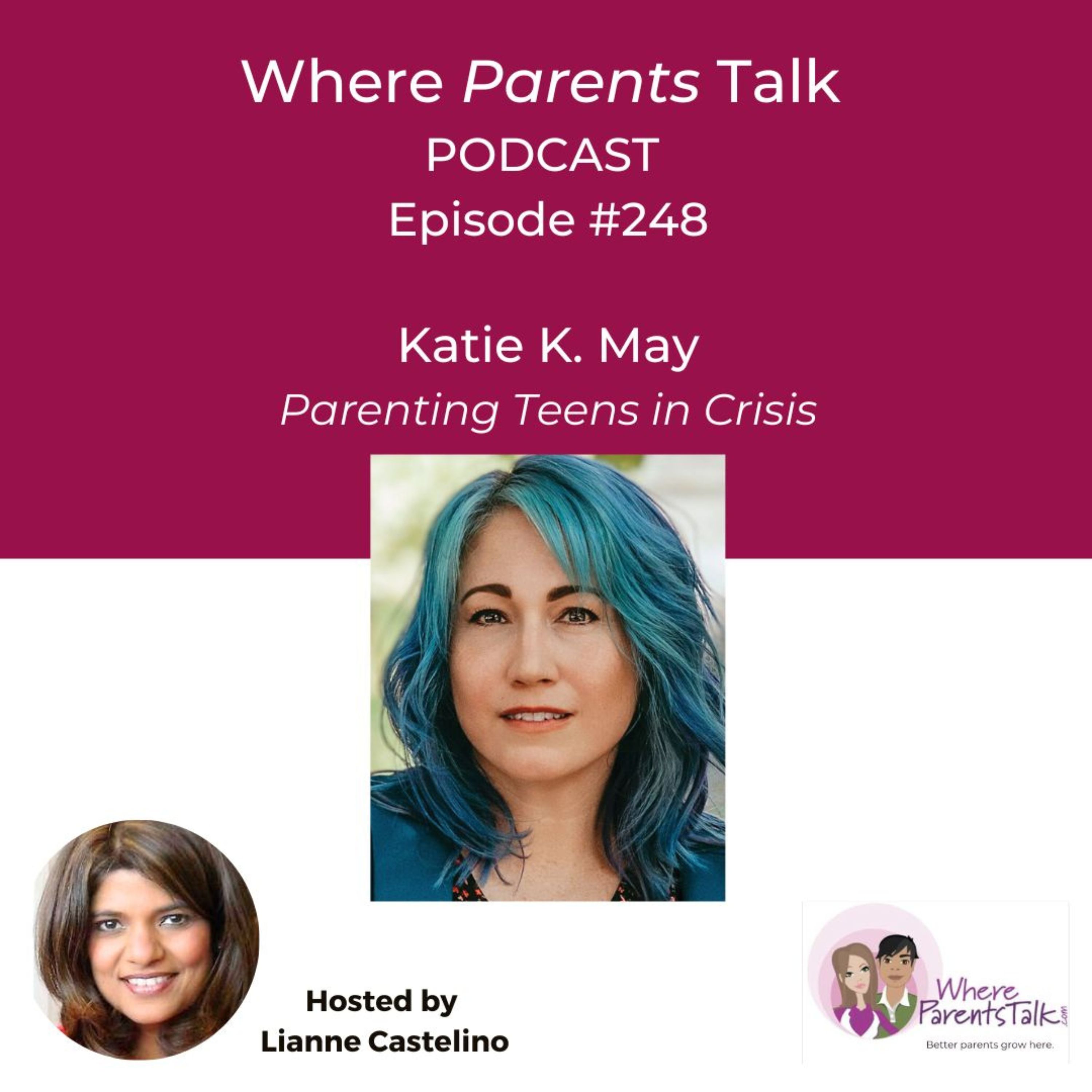
In this episode of Where Parents Talk, host Lianne Castelino speaks to licensed professional counsellor, teen therapist, author and mom Katie K. May about teen mental health.
Drawing from her own experience as a former “teen on fire” and her clinical work with adolescents and families, May unpacks emotional dysregulation, self-harm, and the powerful role validation plays in strengthening parent-teen relationships. She discusses helping parents better understand big emotions, identifying when typical teen behaviour signals deeper concern, and responding in ways that de-escalate conflict rather than intensify it.
May also explains why self-harm is often used as a coping strategy, how parents can regulate their own emotional responses during difficult moments, and practical steps to rebuild trust and connection with a disengaged teen.
Takeaways:
- Navigating the complexities of hormonal changes during adolescence requires open communication and understanding.
- The importance of validation in a teen’s emotional health cannot be overstated; it’s essential for fostering independence.
- Social media can amplify feelings of bullying and anxiety in teens, making emotional support crucial.
- Parents need to recognize the signs of self-destructive behavior early to provide timely intervention and support.
- Establishing a functional emotional system in the family is key to managing discipline and emotional health effectively.
- Building a foundation of consent and mutual respect in relationships can help combat the pressures of social media.
Companies mentioned in this episode:
- Creative Healing Teen Support Centers
This podcast is for parents, guardians, teachers and caregivers to learn proven strategies and trusted tips on raising kids, teens and young adults based on science, evidenced and lived experience.
You’ll learn the latest on topics like managing bullying, consent, fostering healthy relationships, and the interconnectedness of mental, emotional and physical health.
Links referenced in this episode:
Transcript
Welcome to the Where Parents Talk podcast. We help grow better parents through science, evidence and the lived experience of other parents.
Learn how to better navigate the mental and physical health of your tween teen or young adult through proven expert advice. Here's your host, Lianne Castelino.
Speaker B:Welcome to Where Parents Talk. My name is Lianne Castelino.
Our guest today is a licensed professional counselor and a nationally recognized teen therapist in the US Katie K. May is also the founder and executive director of Creative Healing Teen Support Centers, a clinician credentialed in the field of dialectical behavior therapy, and she's also an author. Her book is called you'd're on Fire. It's effective strategies for parenting Teens with self destructive behavior.
Katie joins us today from Philadelphia and she's also a mother of one. Thank you so much for taking the time.
Speaker A:Thank you, Leanne. I'm excited to be here.
Speaker B:Really important topic, certainly for the times that we live in and you've been at this now for over a decade. You described yourself as a teen on fire.
Can you take us back to that time in your life in terms of what it was like emotionally for you and how did those experiences then shape you in the work that you are doing today?
Speaker A:Yeah, I describe myself as a teen on fire or a troubled teen sometimes.
And what I really mean by that is I was a teenager who was quick to experience strong emotions and the emotions that I had were so big that it was hard for me to manage them and led to me engaging in self destructive behaviors like self harm.
An important part of that context is that I was raised by a single father who was thrown into parenting and didn't know how to parent in general, let alone a teenage daughter like me.
And so when I look at my history and I think about what I've been through, my value system has always been learn from my experiences, make meaning for my experiences and help others to shorten the struggle so they don't have to have that much pain in their experience. And that's what led me to where I am today.
Speaker B:So with that backdrop and that context and that lived experience, you know, you talk about motherhood becoming a major turning point for you, being a major turning point for you. So how did motherhood change the way that you understood your younger self and certainly now the teens that you've worked with in the interim?
Speaker A:Yes, finding out I was pregnant was a surprise. And I will say at this point, looking back, while I was terrified and I was not in a good place in my life, it was the best surprise.
And it turned out in the best way. What it forced me to do was to recognize that there was something bigger than the pain inside me.
It forced me to stop focusing on myself as much and realize that there was something important to make changes for which was my child. And so it really was a gift that during my pregnancy I had gotten laid off and so I had had some time and I was.
I did a lot of self reflection, I did a lot of intro, Introspection to learn how to break the chain of generational dysfunction in my family, because there is a lot of it. And part of that learning experience was also my choice to go back to school to become a therapist.
And the rigorous process of becoming a therapist naturally leads to you analyzing a lot about your life and your family. And so the.
The whole process was healing for me in a way that helped me figure out who I am, who I need to be for my child, and what my career looks like.
Speaker B:So when you talk about looking at those generational trauma pieces that you, you know, that you mentioned, like, what did you learn about that in terms of your understanding of your teen experience and then applying it again to the teens you deal with today?
Speaker A:Yeah, I think a big part of the experience that was missing for me as a teenager was validation. Was somebody saying, hey, this is hard for you, or it makes sense that you'd be really sad to not have a mom in your life as a teenage girl.
So a lot of those pieces where I struggled was feeling like my experience was not seen or validated by the caregivers that were in my life.
And so that understanding of what, what a biologically sensitive teenager needs in their life, which is validation, led to my training in dialectical behavior therapy, where one of the two big components is this validation or acceptance piece that we can't move towards change until we're able to say to a person, I see you. I understand why you feel this way. It makes sense that these emotions are coming up for you.
Speaker B:So in your practice, then, how often do you see a lack of validation in terms of the families, the parents, the kids that you deal with?
Speaker A:I want to say 90%. That's not a data driven number, but it's a big percent. So.
So big that one of the entry points we have into our practice is the validation workshop where we're teaching all of the parents who bring their teenagers to us for therapy to learn how to validate. Because when you think about it, a teenager coming to therapy, they've. It's a big Step to ask your parent, hey, I'd like to talk to a therapist.
And so part of that process is teaching parents how to respond to emotions, how to learn the language of emotions, essentially, which is to be able to validate before you try and f or problem solve.
Speaker B:So what does that look like, just in terms of a simple example to the average parent who maybe has never even thought about validation or understands what it means?
Speaker A:There are lots of levels of validation, but at its core, and the simplest piece is being present, paying attention. I'll say your nose goes where your attention flows. So looking at the person, being present with them, being able to repeat back what you heard.
I hear you saying that doing homework right after school is hard for you because you're burned out from a day at school. School. And then looking for an emotion that underlies that.
So as a parent, you're fairly aware of the facial expressions, the tones that mean that your teen is struggling.
So following up on that paraphrasing with saying something like, and I can see how hard this is for you right now, or I see how frustrating it is for you taking a guess on the emotion to try and land underneath the surface of the behavior.
Speaker B:So I'm curious, Katie, what kind of trends are you seeing in your practice? Because we've got what was happening before the pandemic, which was already quite severe in terms of youth mental health.
You had the pandemic and all the stuff that we've all lived through and have stories about, and then you have post pandemic. So are there any common threads in terms of your area of expertise and what you're seeing with young people?
Speaker A:It's interesting. I was just having this conversation with my team about pre and post pandemic patterns.
And what I would say is directly post pandemic, we saw a lot of social anxiety, the fear of going back into school, the fear of actually being in person with other individuals. And so we were doing more anxiety and exposure work at that time of helping folks feel more comfortable in those social settings.
And I would say that that has decreased drastically. And we're back to what I would consider more of a pre pandemic landscape of depress, depression, anxiety, self harm, eating disorders.
I think that they're pretty standard mental health concerns for teenagers who come to our center. And I wouldn't say that they've increased much, but then again, I see them every day, so maybe they have for the general person.
Speaker B:And so when you look at that landscape and you're dealing with those individual kids and families, how much of that would you say stems from kids with big emotions like the ones you described about yourself and, you know, parents maybe not understanding how to deal with that?
Speaker A:Yeah, so everyone's probably heard the term of nature versus nurture. And I look at it similarly. We look at it as biology and environment.
And the way I would describe it to a parent is that some of your kids are born naturally good at sports, some of your kids are born naturally good at art, and some of them are born naturally good at emotions. And what this means is they're more in tuned and in touch with their emotions.
They have a higher reactivity and a slower return to baseline, meaning it takes them a lot longer to calm down than maybe one of their siblings or someone else that you would compare them to.
And if you have that kind of child, but you've never learned how to respond with validation, how to be a container to hold those big feelings, and that child gets the message, my emotions are too big, too much, they're wrong. So that's when you start to see that difficulty in managing emotions.
That's when you see lashing out, self harm, running away, some of the bigger behaviors that are really intended to regulate emotions.
And so I would say that it really is contextual and depends on the family and the teen in terms of some of them are coming in and they have this biological predisposition to emotions, and the environment needs to learn a lot more skills.
And some of them are coming in and they have super supportive environments and they just have a biological predisposition, predisposition for depression or something else. At the end of the day, the treatment looks very similar, how we're supporting teens in getting back to what feels good for them.
But that assessment piece is important when we're starting out.
Speaker B:Absolutely.
And so, you know, when you think back on your situation, what could have helped you when you were trying to manage those big emotions, you know, in your family setting, as you described it, that you didn't get?
Speaker A:Well, I already shared the biggest thing that I didn't get was the validation for my experience. And I think that if I would have had one person to listen or one person to, as I might say it, tell the truth.
And so part of my story is that I didn't have a mom in my life, but nobody was talking about that. Nobody was acknowledging that that was hard or different.
And so if I had had one person to say, I see how hard this is for you, it makes sense because this is a unique situation that is really challenging for a teenage girl to go through. I think it would have made a world of difference to me.
I also think it would have been helpful for my parent that raised me to have his own emotion regulation skills, which is something I talk a lot about with parents. So he would get angry quickly, he would yell, he would be critical, and he didn't have his own skills to manage his emotions.
And so I think if I had had adults in my life who were able to manage their emotions and acknowledge my emotions, things would have been different.
Speaker B:So there's so much that you went through there, Katie, that you're talking about now, like what got you through all that?
Speaker A:It has always been a strength of mine to write, to process my emotions. When I was six years old, I have this vivid visual of me just lying next to my bed writing in my journal. I would write sad poetry and I would cry.
It's always just been the way that I've processed and that's how I wrote a book. I have a contract for a second book I write because it heals me and it's just been who I am and how I process.
And I think when I can, when I can do for myself what I didn't get from others and then I can share that and help others, it helps me to heal.
Speaker B:So talking about the book, we talked about the title, you're on fire. Take us through what fire means. Does it mean the big emotions?
And also how do parents get from a place of seeing that fire playing out or seeing those emotions playing out and accepting them, saying to themselves, it's fine that my child is expressing him or herself this way?
Speaker A:Yeah, so you're on fire, it's fine came from this concept of when you are someone who has big emotions, it feels like you're on fire with those emotions. And that's often where these self destructive behaviors come from. The brain will do anything to try and help those emotions come down.
And so the it's fine part is kind of tongue in cheek. It's tongue in cheek. It's parents saying like, you're fine, take a walk, you must be hungry, go take a nap. It's the minimization of their emotions.
And so when I'm talking about this with parents, I'm often saying like your teen is on fire with emotions. And when you tell them, go look at your list of coping skills, it's like using a little squirt gun.
It's not enough to put the fire out and sometimes it makes them feel worse. Like they should be able to put the fire out with that little bit of water that you're, you're sending their way.
And your question, how do we get parents from this point place of invalidating to supporting? It starts inside for them. It starts with an awareness of their own emotions and an ability to cope with and manage without reacting.
We've all heard the idea of modeling emotions so that our children can see that. And it is true in that sense of modeling emotions. But it's also, it's called the transactional model.
What I do influences you and, and what you do influences me. And so an example of that that's in the book and that I use often is a teenager.
This probably has happened 100 times since I started practicing as a teen therapist. A teenager will say, I just need a break. I need to go to my room. I need some space.
And the parent will perceive that as disrespectful or against what they're hoping for. And so they will follow after the teen and say something like, we need to solve this right now. Don't you walk away from me.
Don't you slam that door at me. And then the situation blows up and they say, teenager, you really can't handle your emotions. You really are going off the deep end.
When in fact, if they had given their child a break, they might have both had an opportunity to calm down and come back together with a more productive conversation.
And so when I think about that, that concept that plays out all the time in different situations, I think that if the parent could tolerate not solving the problem right away, could think, let me go take a walk, let me go lie in bed and scroll on my phone for a while, let me go talk to my partner and get support, then the situation may not have escalated. Well.
Speaker B:And you know, as you're describing that we've all been there, right. Probably multiple times. And it's a very sort of relatable example, definitely.
But in that moment when the emotions and, you know, potentially on both sides are pretty high, how can a parent say to themselves, I have got to. Because it's a discipline. Right. It's got to be an intentional decision.
It's a discipline to say, I'm going to step away from this, I'm going to take a deep breath, I'm going to count to three, whatever it is, for you to devolve and de escalate the situation as opposed to, to your point, making it worse.
Speaker A:Yeah. And I do want to acknowledge that we're all doing the best we can with the skills that we have.
And so this is certainly not to say that it's the parents fault or parents are the problem because I don't believe that. And I do believe that as parents we go first and we need to learn the skills first.
And so when I think about, you know, well, how, how do we do this when everyone is so entrenched in this cycle and everyone's emotions are high? It takes practice. And the first step in that practice is the awareness. And that's why we hear things about mindfulness being so effective.
Mindfulness doesn't have to be sitting down and meditating, but noticing what emotions are showing up in our body. And maybe this time I'm a recovered yeller and so I will share that.
I used to yell at because I have trouble managing my emotions as we've established.
And so maybe this time I did y at my child but I noticed that before I yelled I got this boiling sensation in my chest like a volcano was about to erupt. Then next time maybe I notice that volcano and I say I'm about to blow up, I need to leave the room.
And maybe it sounds kind of angry or abrupt, but it's more skillful than the time before when we yelled. So I don't think it's a 0 to 60 or 0 to 100 process. It takes time and it takes practice.
And the only way that we can do that is to look at what happened, look where things went sideways and then make a different decision next time to do it just 10% differently until we've got it on track.
Speaker B:So building on that point, you talk about building a system that works for the whole family. What does a functional emotional system look like? Ideally for a family, it's communication.
Speaker A:And that looks different depending on what the family system is, the neurodivergence in the family, preferred communication strategies. But what it looks like is that everyone is responsible for themselves and their emotions.
Obviously you're responsible for your children, but in this sense, in the sense of emotion regulation and communication, I'm responsible for managing my emotions. And that could look like going to do something to cope or going to a parent to seek support and talk about my feelings.
And parents are responsible for managing their emotions, going to a support, not going to their child for support, going to a support, doing things to manage their emotions, proactive self care. And everyone is responsible for communicating directly what their needs are or what they're feeling.
And what that does is that it, it takes the pressure off of me to guess how you're feeling. So if you're my child, I Don't have to say what's wrong, what's wrong.
I know, because we've all established that we're responsible to communicate and to regulate.
And it takes the pressure off a child who may be in a dysfunctional family setting like I, where you're constantly scanning your environment to make sure that the parents are okay so that you don't have to do something to manage that.
Speaker B:That's a really interesting point.
So I'm curious, Katie, what did you do with your child based on your experience that you know you did intentionally because you had all of this knowledge that you gained, not to mention what you do on the day to day?
Speaker A:Yes, I overcorrected and I made mistakes. And I say that because I think it's, it's helpful to hear like, yes, this has been my life's work and I'm not a perfect parent.
And so a lot of what I did was over correction where I never got validation. And so there were times when I wanted to make sure that my child's emotions were validated. For example, they had a about of not going to school.
And so I'd be like, well, what if this is the time that they actually have a stomachache? What if this is an anxiety that time? I don't want to invalidate their experience experience.
And it took a long time with going to therapy for my teen, for my child and my teen, and getting support from therapists for us and our family to figure out what that right line was. And I do think differently. We have mutual trust, communication. I don't hold back, I'm transparent.
And we can, we can have conversations that I wasn't able to have in my family. But it did take time to calibrate how to accurately validate without overcorrecting.
Speaker B:That's interesting. Many parents feel powerless, especially if their teen engages in self harm or risky behaviors. And you know, adolescence is rife with risky behaviors.
That's part of the developmental stage that it is.
But what is are some of the common misconceptions, Katie, that you can share about why teenagers would engage in self harm and these types of risky behaviors? Yeah.
Speaker A:So if we go back to that idea that teens can feel on fire with their emotions, many, for many people, if not all people, I would say feeling on fire is an intolerable feeling. And so when that occurs, an individual's brain will start to come up with strategies for relieving that fire, for putting the fire out.
And so that's the idea behind self harm behaviors, is that I have an Emotion that is bigger than my ability to cope with it and that's how I make it go away quickly. So when we look at self harm or self destructive behaviors, what I like to see or what I like to say is that the problem is actually the solution.
For us as adults and people who care about this child, we see this as a problem. I don't want my child to hurt themselves. That hurts me. I don't want them to do something to make it worse or you know, make the risk higher.
And for the teen that's engaging in that behavior, it's actually helping them. And that's where therapy becomes so important because we really tease apart those micro moments of what did this do for you?
And how can we replace that with something else that's equally effective but way less destructive.
Speaker B:So then building on that point, what would you say to a parent to help them distinguish between typical team teen angst and overwhelm and something that requires more intervention? And you're just using the emotional sort of radar as a parent to figure this out.
Speaker A:It's one of the biggest questions I get. Is this typical or is it cause for concern? And I like to think about severity and timeline.
So first off, if you're seeing a behavior that maybe your teen spending more time in their room, maybe your teen's mood is more angsty, is it constant? Has it been two weeks of this constant behavior? If so, I would say that might be cause for concern.
And the first step I would encourage is reaching out to a therapist or talking to your teen directly about going to see a therapist. But as you mentioned, teenagers are moody. Teenagers might be more reactive.
So I think the line for me is the amount of time that it's happening consistently and two weeks is usually my mark.
That being said, the severity response would be more like if it's anything that is self destructive, if it's any substances beyond what might be typical teen experimentation in terms of drugs and alcohol, I'll let parents decide their limit on that. I know I have mine. And.
Or if it's anything where the teen is hurting themselves or considering suicide, that would be a metric for me that right away they should get into some kind of support.
Speaker B:When you think back on your own experience with respect to self harm that you talked about at the beginning of our interview, what led you to that as you reflect back on it?
Speaker A:I can remember it clearly.
I had actually snuck out of the house and I was with a group of friends in a neighborhood maybe like down the street from ours, that we had to take a bus to get to.
And one of the people that I was with was an older kid and he was listening to it, we were playing music, he was listening to a song and he self harmed in front of me. And I had never seen that behavior before and I didn't really know what to think of it.
But when I got home that night, I was in trouble because I had snuck out that day and it was before cell phones so my dad didn't know where I was the entire day.
And what happened was I had a shame response to my dad's reaction to me and it was almost instinctual that I then chose to self harm and it, it did provide relief in that moment and that's what started the cycle. And I think that that's typical for teenagers is that they learn about it from a peer but then don't. Nobody wants to self harm.
So in a moment it's almost like an instinctual reaction of this seems like it could help.
Speaker B:You talked about as well generational cycles of pain and you know, many people experiencing that. What are some signs that first of all people may be repeating these emotional patterns over generations and how can they start to change the course?
Rewrite that piece.
Speaker A:I would say anyone who's having thoughts like I, I was raised like this and there and I turned out fine, this is the right way and or thoughts like mine that are over correction thoughts of I was raised like this so I'm going to do the complete opposite. That's an emotional reaction as well.
So those are two cognitive pieces that I would say if you're noticing signs like you're trying to justify how you're parenting because of how you were parented, that might be a sign that seeking your own support as a parent would be important.
The other piece I would say is if you're having an intense body or emotional reaction to something your teen is saying or doing, it could be because it's rooted in your own childhood and how you were parented.
So a lot of the work we're a teen support center, but a lot of the work we do is helping parents with their family of origin story so that they can parent from a regulated place and not from that reactive place where they were actually a wounded child.
Speaker B:What was your tipping point, Katie, for writing the book?
Speaker A:I always knew I wanted to be an author. As I told you, I've been writing my whole life, so it's been a goal since I was very young.
My tipping point was maybe five years into my group practice. I lead a team of about 20 therapists and we were noticing skills gaps for the parents that were bringing their teenagers into therapy.
And so I thought we need to get these skills out there in a way that's accessible for all parents, not just the parents who can come into our center and get support.
Speaker B:And what kind of impact have you seen in that time? Because you certainly have seen, I'm thinking, an increase in the number of kids and families that you're dealing with.
Speaker A:Yeah, I think it's been an amazing impact for me. It's fulfilling to I get DMs or emails from parents across the nation and in Canada who said, I've read your book, it's been so helpful.
And I hear things about how they've been able to shift their perspective to parent their teen, but also how they've been able to manage their own emotions.
And I think a big piece of it that I wasn't expecting was them saying, well, I read your story and so I know you struggled and got through it and that gives me hope. And that part wasn't my intention, but it feels almost the most meaningful to.
Speaker B:Me along those lines, because you talked about awareness and the importance that that plays in, in what we're talking about, I wonder if you could sort of expand a bit on self compassion and what role does that play for parents and for the child?
Speaker A:Yeah, so when I was in graduate school, I was in a class where the, the teacher essentially was saying, parents are always going to mess up their children and it's all your fault. So the opposite of what I said maybe 15 minutes ago.
And at that time my child was almost two years old and I raised my hand timidly and said, so you mean I'm definitely going to mess up my child? And then she, she softened a bit and she shared about the good enough parent theory.
And what this says is that parents only need to be good enough or get it right 20% of the time. And 80% of the time it's about how they manage and make repairs.
And so when I think about that through the lens of self compass, to me that says that we can be so kind to ourselves even if we only get it right 20% of the time? Because the research says that's all that's required for our kids to be okay.
Speaker B:What would you say to a parent in terms of how they can get their teen back if their teen is pulled away or is shut down, in terms of getting the communication going again? And in some cases maybe the communication wasn't great to start With. But what can you offer those parents in terms of, you know, optimism and hope?
Speaker A:Yeah, there's something I describe in my book called the hierarchy of connection, and it's three levels. In the first level, it's asking, can you sit in the same room as your child? Maybe you're doing completely separate things.
My example is always your kid is watching YouTube while you're making dinner. And you're not criticizing, you're not arguing. There's not intense tension.
And once you can accomplish that, the next level would be, can you do something side by side with your teen without tension, without criticizing? Maybe you're watching a movie, maybe you're driving in the car. Car and listening to music.
And once you can accomplish that, can you have an interactive conversation with your teen without tension and without criticism? And this might take a very long time.
You might spend a year just in the same space as your teen without any interaction before it moves on to the next level. And again, like, going from 0 to 100 doesn't happen. So we want to be systematic about it.
It's also important to have some acceptance around what is realistic for the relationships in life. I talk about how with my dad, we never really got to that interactive point. We're more side by side in our communication and our relationships.
So he helped me open my teen support centers. He did the construction for my spaces, and. And that was a moment of being able to share something with him at his level of capacity.
But we're never going to have deep conversations about emotions because that's not who he is.
So I've come to accept that and I share that example so that we can have realistic expectations for the parents or children in our lives and what they're capable of and aim for that level in the hierarchy of connection.
Speaker B:In your role as a mother, you shared about overcorrecting in some cases.
I wonder how stringent and disciplined if you were those things about communication with your child, because as you said, that is at the root of really what we're talking about here. And in some families, with generations and all the rest of it, the Internet, social media, et cetera, et cetera, communication is very different.
And so how did you go about prioritizing communication as a mom?
Speaker A:Communication has always been at the core of my relationship with my child. And I think along with that, a mutual respect. And so I had shared with you before we started recording that I. My.
I have an understanding with my child where I don't share anything personal about their demographic other than that I have a Teenager, because that's what they've asked of me. They don't want to be an example in my work. They don't want me to share pictures of them on my social media.
And so I have always respected that you are an autonomous human being. Even if you're an 8 year old, you are still a person and I will respect your boundaries.
And I think that has gone a long way in us being able to communicate with each other because it doesn't feel one sided, it doesn't feel oppressive or like there's a dominant side. Of course I'm the parent and I make the decisions and we have boundaries at home.
But there's a lot of space and respect for my child's needs, thoughts and opinions as their own human being. So I think at the core that's what has helped us to have such a good relationship.
Speaker B:Is there a particular example, Katie, of a family, a child that you helped, who came in with on fire and who, you know, you helped and saw this massive transition with respect to that individual or their family as well?
Speaker A:Yeah. So I can share generally that one of my favorite success stories have, or I would say a collection of.
But how I share it is the teenager that came in and parent was sure that they weren't gonna make it at home. I think, you know, sophomore, junior year, I'm sending them to a residential treatment center. I don't think they're gonna make it to college.
Our relationship is in the trash. It will never. Both parent and teen came into our center. They went through our parent and teen programming and it repaired the relationship.
They had harmony at home for the rest of high school and the child went to college. And it was one of our success stories of getting those emails of like thank you.
We're in a different place because of the program that we went through. So that's standard for the kind of work that we see at our center.
Speaker B:And what's the core of that parent child program? If you were going to sort of drill it down to what is the root of that success, what is that?
Speaker A:It is. So our program is based in a therapy called dialectical behavior therapy. And the root of that is number one, that validation piece.
Validation before change.
The change looks like awareness of my emotions, strategies to regulate my emotions and then strategies to communicate my emotions, get my needs met and improve the relationship. That's a very stripped down version, but that's what the program looks like that they go through. It's a 24 week program at our center.
Speaker B:If there is one thing that you would like parents to take away or readers of you're on Fire. What would that be?
Speaker A:I would say that it's so important to keep trying and that it's hard because it takes a long time for change to happen.
But I like to remind parents that the work that you're doing now is not just about getting your teen to college, but about paving the way for a relationship where they come back after college and they want a relationship with you.
Speaker B:Lots of wonderful advice and food for thought. Katie K. May, licensed professional counselor and author of youf're on Fire. Really appreciate your time and your perspective today. Thank you.
Speaker A:Thank you. To learn more about today's podcast, guest and topic, as well as other parenting themes, visit whereparentstalk.com.